
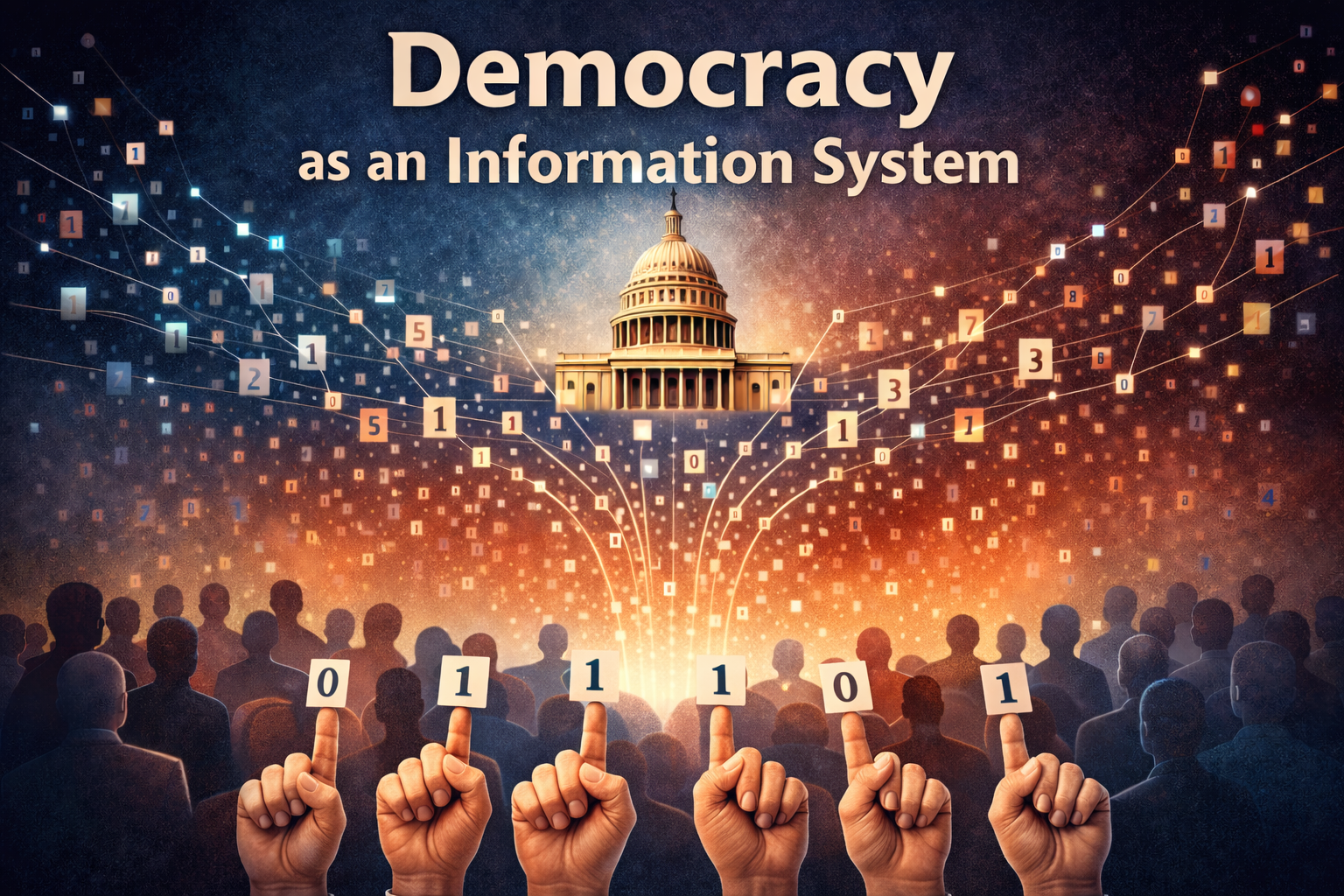
Democracy as an Information System
A democracy is, at its core, a bottom-up system. Its defining feature is that information flows from individuals up to shape collective decisions. Citizens signal their preferences about taxes, healthcare, the environment, and countless other issues. Ideally, the political system responds.
Contrast this with a top-down system, where decisions originate at the center and flow outward.
In our capitalist societies, we constantly send information through markets. Every purchase is a vote for a product, a company, a price point. These daily transactions form a massive stream of information that shapes the economy.
But in politics, the most concrete and binding form of information input is the vote. Polls and surveys provide additional data, but they are non-binding and can be biased, manipulated, or ignored. Elections remain the primary channel through which citizens transmit authoritative information into the political system.
This raises an important question:
How much information is actually contained in a ballot?
Measuring Information: Bits and Fingers
To answer that, we need a way to measure information. The basic unit of information is the bit, short for binary digit. A bit represents a choice between two possibilities: yes/no, 0/1, on/off.
We can understand this intuitively using our hands.
Most people think you can at most count to ten using your fingers. That’s true if you count sequentially: raise one finger per number. This equates to about 4 bits of information. Just count the digits of ten in binary: 1010.
But there’s another way.
If you treat each finger as a binary switch – up (1) or down (0) – each finger represents a power of 2. Because each finger can independently be up or down, ten fingers give you 10 independent bits of information.
With ten independent binary digits, you can represent numbers from 0 to 1023. That’s 2¹⁰ possibilities. I recommend you to watch this excellent video of 3Blue1Brown for a better explanation.
Why is this so much more informative than sequential counting?
Because in the binary method, each finger acts independently. Independent signals add information linearly. The number of possible combinations grows exponentially.
In sequential counting, the fingers are not independent. Once you know the highest raised finger, the rest are predetermined. The informational content grows only logarithmically.
This distinction – independent versus dependent signals – is crucial, because systems that restrict independence create informational bottlenecks.
The Information We Send to the Economy
Let’s estimate how much information we send into the economy.
Suppose you buy one item per day. Amazon reportedly lists around 600 million products. Let’s assume your real choice space is even larger – say 6 billion products. Choosing one product out of 6 billion possibilities represents roughly:
log₂(6,000,000,000) ≈ 37 bits of information.
That’s per day.
Even with this conservative estimate, the informational bandwidth of market participation vastly exceeds that of electoral participation.
The Information in a Ballot
Now consider a U.S. congressional election. There may be four candidates on the ballot, but realistically two major contenders (Democrats and Republicans) dominate. Choosing between two meaningful options corresponds to:
log₂(2) = 1 bit of information.
One bit. Every four years.
Even if we include presidential, state, and local elections, the total information transmitted over four years may not exceed 10 bits.
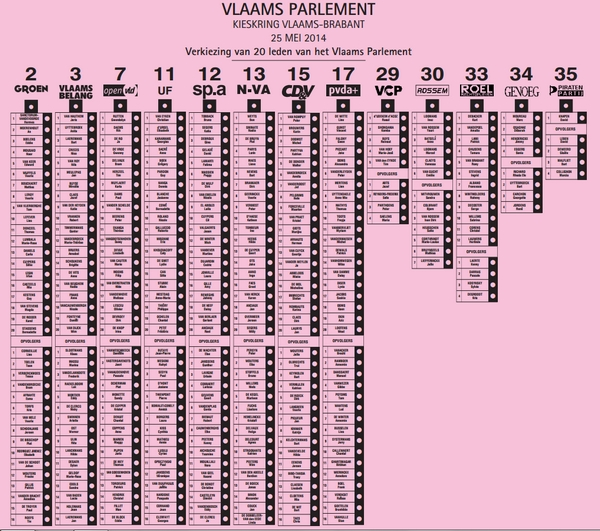
Now consider Belgium, my home country. Belgian ballots can contain over 200 names across party lists. At first glance, that seems information-rich.
But in Belgium’s proportional voting system, what ultimately matters is the distribution of votes across parties. Within each party list, you may indicate a preference for a specific candidate, but party discipline typically ensures unified voting behavior.
If 13 parties meaningfully compete, the informational content is:
log₂(13) ≈ 4 bits.
Despite the ballot’s visual complexity, the amount of effective information remains very limited.
The Bottleneck of Exclusive Representation
Why is this happening?
Because representative democracy is structured as an exclusive system. You choose one party. By doing so, you automatically reject all others.
This is analogous to sequential finger counting: once one choice is selected, all others are implicitly excluded. The signals are dependent rather than independent.
The result is again an informational bottleneck.
Our democracies have scaled to millions of voters – but not to millions of nuanced preferences. We have scalability in participation, but not in preference representation.
When Information Is Scarce, Tribalism Fills the Gap
Here is where the consequences become serious.
If the system receives only a few bits of information from each citizen, what can it realistically detect?
It cannot detect nuanced policy trade-offs.
It cannot detect intensity across dozens of independent issues.
What it can reliably detect is group alignment.
If I only send one bit – effectively “Party A” or “Party B” – the system does not learn what I think about healthcare, migration, defense spending, education reform, or climate policy individually. It learns only which tribe I belong to.
In other words:
When democracy is starved of information, it defaults to tribalism.
And once politics becomes primarily about tribal alignment, several predictable effects follow:
- Polarization increases
- Ideological rigidity strengthens
- Compromise becomes betrayal
- Policy becomes secondary to loyalty
It is not that voters are inherently tribal.
It is the structure of information that forces politics into tribal categories.
When you only allow one dependent signal, you shouldn’t be surprised when politics reduces to “us versus them.”
Can We Do Better?
Yes.
In a direct democracy, citizens vote on individual proposals. Each proposal is independent. A yes/no vote on each measure contributes one bit.
A ballot containing 200 independent proposals would carry 200 bits of information or about 25 bytes.
That is exponentially richer than choosing one party.
Our political systems, however, compress vast political diversity into a handful of mutually exclusive party options.
Toward Non-Exclusive Representation
The problem with representative democracy is not that it is representative.
It is that it is exclusive.
To illustrate the principle, consider the game “Who Is It?”. Players ask yes/no questions to narrow down a hidden character. Each independent question halves the search space. This is essentially a binary search. Small children intuitively learn how to extract information efficiently by asking independent questions.
With a limited number of independent questions, we can narrow the search space to a single individual. Replace visual attributes for political preferences and questions for parties. We can now represent each individual’s needs in a vast population with a limited number of independent parties.
What if multiple parties could simultaneously represent a single person?
In my book The Flaws That Kill Our Democracies, I outline a system in which voters are not limited to a single party affiliation. Preferences can be distributed across multiple representatives.
This preserves scalability in the number of voters while dramatically increasing scalability in the information transmitted about political preferences.
Such a system would:
- Increase electoral bandwidth
- Reduce lobbyist impact
- Reduce polarization
- Decrease ideological dependency
- Strengthen democratic resilience
How information is processed and aggregated is, of course, another challenge entirely.
But one thing is certain: You cannot use information that is never transmitted.
Today, our democracies are dying of information starvation.